Stopping is banned in places where a stopped vehicle would be dangerous or would block others: in a railway reserve at a level crossing, in a tunnel, within 6 m of a bridge, within 9 m of the approach side of a pedestrian crossing, and anywhere facing oncoming traffic.
The exception is always the same: you must stop when a traffic officer or a sign tells you to, or to avoid a collision.
Where may you legally stop with your motor vehicle?
- 5m from a tunnel
- 6m from a level crossing
- 8m from a pedestrian crossing
- None of the above
Show the answer
Answer: B. 6m from a level crossing
Stopping is only illegal within set distances of hazards. 6 m from a level crossing is far enough away, while 8 m from a pedestrian crossing is still inside the 9 m no-stopping zone.
You are not allowed to stop:
- In front of a police officer
- With the front of your vehicle facing oncoming traffic
- Next to an emergency vehicle
- Next to any obstruction in the street
Show the answer
Answer: B. With the front of your vehicle facing oncoming traffic
You must always stop or park facing the same direction as the traffic in your lane, never with your vehicle facing oncoming traffic.
You are not permitted to stop:
(i) within a railway reserve at a level crossing(ii) on the right hand side of a road facing oncoming traffic(iii) in a tunnel
- (i) only is correct
- (ii) only is correct
- (iii) only is correct
- All of the above are correct
Show the answer
Answer: D. All of the above are correct
You may not stop in a railway reserve at a level crossing, facing oncoming traffic on the right-hand side of the road, or in a tunnel. All three are banned.
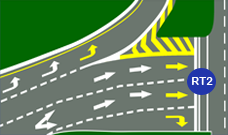
Road marking RT2 in the sketch below
(i) Show you that you may not stop further than the front one of the two.(ii) Are lines where pedestrians walk.(iii) Are lines that indicate another traffic line.

- (i) only is correct.
- (ii) only is correct.
- (iii) only is correct.
- All of the above are correct
Show the answer
Answer: B. (ii) only is correct.
These markings show a pedestrian crossing: the lines between which pedestrians walk across the road.
You must stop your vehicle:
(i) On a public road at the signal of a person driving sheep.(ii) On a freeway when directed to do so by a traffic officer.(iii) On any road to avoid an accident.
- (i) only is correct.
- (ii) and (i) are correct.
- (iii) only is correct.
- All of the above are correct
Show the answer
Answer: D. All of the above are correct
You must stop when a person in charge of animals signals you to, when a traffic officer directs you to on a freeway, and whenever you need to avoid a collision. All three are correct.
Where may you legally stop with your vehicle
(i) 4m from a tunnel.(ii) 5m from a pedestrian crossing.(iii) 6m from a railway crossing.
- (i) and (iii) are correct.
- (ii) and (iii) are correct.
- (iii) only is correct.
- None of the above are correct
Show the answer
Answer: C. (iii) only is correct.
Of these, only 6 m from a railway crossing is outside the no-stopping zone. 4 m from a tunnel and 5 m from a pedestrian crossing are both too close.
To slow down or stop your vehicle use:
(i) the gears and brakes(ii) the brakes only(iii) the handbrake
- (i) only is correct
- (ii) only is correct
- (iii) only is correct
- None of the above are correct
Show the answer
Answer: B. (ii) only is correct
In the K53 method you slow down and stop with the brakes. Gears are chosen to suit the speed you are already at; they are not used to slow the vehicle down.
When you were involved in an accident you:
(i) Must immediately stop your vehicle.(ii) Must determine the damage to the vehicles.(iii) May refuse to give your name and address to anyone except the police.
- (i) and (iii).
- (ii) only is correct.
- (i) and (ii) are correct.
- None of the above are correct
Show the answer
Answer: C. (i) and (ii) are correct.
After a collision you must stop immediately and establish the damage. You must also give your name and address to anyone with good reason to ask, not only to the police.
You are not allowed to stop:
(i) on the pavement (ii) with the front of your vehicle facing oncoming traffic (iii) next to an obstruction in the road
- (i) only is correct
- (ii) only is correct
- (iii) only is correct
- All of the above are correct
Show the answer
Answer: B. (ii) only is correct
You may not stop with the front of your vehicle facing oncoming traffic. Always stop on the left, facing the same way as the traffic in your lane.
When you were involved in an accident you:
(i) Must immediately stop your vehicle.(ii) Must see if someone is injured.(iii) May use a bit of alcohol for the shock.
- (ii) only is correct.
- (i) and (ii) are correct.
- (ii) and (iii) are correct.
- None of the above are correct
Show the answer
Answer: B. (i) and (ii) are correct.
After a collision you must stop immediately and check whether anyone is injured. Alcohol is never acceptable, even for shock.
You are not allowed to stop:
(i) Where you are also prohibited to park. (ii) 5m from a bridge. (iii) Opposite a vehicle, where the roadway is 10m wide.
- (i) and (iii).
- (ii) only is correct.
- (i), (ii) and (iii) are correct.
- None of the above are correct
Show the answer
Answer: B. (ii) only is correct.
You may not stop within 6 m of a bridge, so 5 m is too close. On a roadway 10 m wide you may stop opposite another vehicle.
You are not allowed to stop:
(i) On the pavement. (ii) With the front of your vehicle facing oncoming traffic. (iii) Next to any obstruction in the road.
- (ii) only is correct.
- (i) only is correct.
- (ii) and (iii) are correct.
- All above are correct
Show the answer
Answer: A. (ii) only is correct.
You may not stop with the front of your vehicle facing oncoming traffic. Always stop on the left, facing the same way as the traffic in your lane.
If your vehicle is involved in an accident you must
(i) Immediately stop your vehicle (ii) Ascertain the nature and extent of any injuries (iii) Drink a bit to calm your nerves down
- (iii) only
- (i), (ii), (iii)
- (i), (ii)
Show the answer
Answer: C. (i), (ii)
After a collision you must stop immediately and find out whether anyone is injured and how badly. Drinking alcohol to calm down is never acceptable.
You are not allowed to stop
- When the front of your vehicle is facing oncoming traffic.
- In front of a police officer.
- Next to an emergency vehicle.
Show the answer
Answer: A. When the front of your vehicle is facing oncoming traffic.
You may not stop with the front of your vehicle facing oncoming traffic. Always stop facing the same way as the traffic in your lane.
You are not allowed to stop...
(i) On the pavement. (ii) With the front of your vehicle facing oncoming traffic. (iii) Next to any obstruction in the road.
- (ii) Only is correct
- All of the above are correct
- (ii) and (iii) Only are correct
Show the answer
Answer: B. All of the above are correct
You may not stop on the pavement, facing oncoming traffic, or next to an obstruction in the road. All three are correct.
When you were involved in an accident you...
(i) Must immediately stop your vehicle. (ii) Must determine the damage to the vehicles. (iii) May refuse to give your name and address to anybody except to the police.
- (i) Only are correct.
- (i) and (ii) Only are correct.
- All of the above are correct.
Show the answer
Answer: B. (i) and (ii) Only are correct.
After a collision you must stop immediately and establish the damage. You must also give your name and address to anyone with good reason to ask, not only the police.
Where may you legally stop your vehicle?
- 4 m from a tunnel.
- 5 m from a pedestrian crossing.
- 6 m from a railway crossing.
Show the answer
Answer: C. 6 m from a railway crossing.
Of these, only 6 m from a railway crossing is outside the no-stopping zone. 4 m from a tunnel and 5 m from a pedestrian crossing are too close.
You are not permitted to stop...
(i) If ordered to do so by a police officer. (ii) On the right hand side of a road facing oncoming traffic. (iii) Within a railway reserve at a level crossing. (iv) In a tunnel.
- (i) Only is correct.
- All of the above are correct
- (i), (iii) and (iv) Only are correct
Show the answer
Answer: B. All of the above are correct
The expected answer is 'all of the above'. Stopping facing oncoming traffic, in a railway reserve at a level crossing, or in a tunnel are all banned. (Note: you must always stop when a police officer orders you to; the wording of this question is confusing.)
The procedure following an accident is...
(i) to immediately stop your vehicle. (ii) to inspect to determine if anyone is injured. (iii) to drive off if you are uninsured.
- (i) and (ii) Only are correct.
- (i) Only is correct.
- All of the above are correct.
Show the answer
Answer: A. (i) and (ii) Only are correct.
After a collision you must stop immediately and check whether anyone is injured. Driving off is never allowed, insured or not.
You are not allowed to stop...
- 5 m from a bridge.
- In a place where you are not allowed to park.
- Opposite a vehicle where the roadway is 10 m wide.
Show the answer
Answer: A. 5 m from a bridge.
You may not stop within 6 m of a bridge, so 5 m is too close. On a roadway 10 m wide you may stop opposite another vehicle.
You are not allowed to stop...
- Where you are also not allowed to park.
- 5 meters from a bridge.
- Opposite a vehicle where the roadway is 10 meters wide.
Show the answer
Answer: B. 5 meters from a bridge.
You may not stop within 6 m of a bridge, so 5 m is too close. On a roadway 10 m wide you may stop opposite another vehicle.
On a public road you may not stop your vehicle...
- 9 metres from a pedestrian crossing
- Within the railway reserve at a level crossing
- 11 metres from a tunnel
Show the answer
Answer: B. Within the railway reserve at a level crossing
You may not stop inside the railway reserve at a level crossing. The other distances given are outside the no-stopping zones.
You may only stop your vehicle on a no stopping zone...
(i) if a traffic officer orders you to do so (ii) for situations beyond your control (iii) if you are trying to avoid an accident.
- (i) and (iii) are correct.
- (iii) only is correct.
- All of the above.
Show the answer
Answer: C. All of the above.
You may stop in a no-stopping zone when a traffic officer orders you to, for reasons beyond your control, or to avoid a collision. All three are correct.
You may not stop your vehicle...
- When a traffic officer instructs you to do so.
- Within 6 metres of any bridge, tunnel or subway.
- If your vehicle brakes are faulty.
Show the answer
Answer: B. Within 6 metres of any bridge, tunnel or subway.
You may not stop within 6 m of any bridge, tunnel or subway.
Which sign is stricter: no stopping or no parking?
- No stopping
- No parking
- They mean the same
Show the answer
Answer: A. No stopping
Where you may not stop, you may not park either. No stopping means you may not halt at all, even briefly.
When may you stop in a no-stopping zone?
- When quickly dropping off a passenger
- When a traffic officer instructs you to
- After business hours
Show the answer
Answer: B. When a traffic officer instructs you to
You may stop where it is normally banned only when ordered by a traffic officer, to avoid a collision, or for reasons beyond your control.
You may not stop within … of a bridge.
- 3 m
- 6 m
- 12 m
Show the answer
Answer: B. 6 m
Stopping within 6 m of a bridge, tunnel or subway is not allowed.