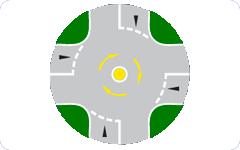
Four-way stops and traffic circles have different right-of-way rules, and the learner’s test checks that you know which is which. At a four-way stop, and at a mini-circle, the first vehicle to stop is the first to go. At a traffic circle you yield to traffic already in the circle, coming from your right. When robots are out of order or flashing red, treat the junction as a four-way stop.
Read the full guides to four-way stops and traffic circles, then test yourself below.
When do you have the right of way?
- When you have stopped first at a 4 way stop
- When you want to turn right at an intersection in a two-way road
- When you are within a traffic circle
- A and C above
Show the answer
Answer: D. A and C above
You have right of way at a four-way stop if you stopped first, and inside a traffic circle over vehicles waiting to enter. Turning right does not give you right of way: you must yield to oncoming traffic.
When arriving at a traffic circle:
- Vehicles in the circle already, have right of way
- Vehicles on your left, have right of way
- Vehicles on your right, have right of way
- A and C above
Show the answer
Answer: D. A and C above
At a traffic circle, vehicles already in the circle have right of way, and you give way to traffic on your right.
When approaching a four-way stop:
- Stop if you feel it is necessary
- The first vehicle to stop, should be the first to proceed, if safe to do so
- The person who indicates first, should be the first to proceed
- Slow your vehicle down and if safe to do so proceed
Show the answer
Answer: B. The first vehicle to stop, should be the first to proceed, if safe to do so
At a four-way stop, the vehicle that stopped first goes first, as long as it is safe. Signalling first does not give you priority.
If you are driving towards a mini-circle and there are also vehicles from the other three sides you:
(i) Must always wait for the vehicle from your right before you drive on. (ii) May drive on if you were the first vehicle over the line. (iii) Must stop with all the vehicles and only drive on when it is save.

- (i) only is correct.
- (ii) only is correct.
- (iii) only is correct.
- All of the above are correct
Show the answer
Answer: B. (ii) only is correct.
At a mini-circle, the vehicle that reaches the line first may go first, as long as it is safe.
When do you have the right of way?
(i) When you are within a traffic circle.(ii) When you have stopped first at a four-way stop.(iii) When you want to turn right at an intersection in a two-way stop intersection.
- (ii) and (iii) are correct.
- (i) only is correct.
- (i) and (ii) are correct.
- All of the above are correct
Show the answer
Answer: C. (i) and (ii) are correct.
You have right of way inside a traffic circle and when you stopped first at a four-way stop. When turning right you must yield to oncoming traffic.
At a four-way stop:
(i) you may pass through the intersection without stopping if no other vehicles are present (ii) you must stop and drive off only when it is your turn (iii) both of these
- (i) only is correct
- (iii) only is correct
- (ii) only is correct
- All of the above are correct
Show the answer
Answer: C. (ii) only is correct
At a four-way stop you must always stop, even if no other vehicle is there, and drive off only when it is your turn.
At a traffic circle:
(i) yield to vehicles coming from your right (ii) yield to vehicles coming from your left (iii) the same rules apply as with a 4-way stop
- (i) only is correct
- (ii) only is correct
- (iii) only is correct
- None of the above are correct
Show the answer
Answer: A. (i) only is correct
At a traffic circle, yield to vehicles coming from your right. It is not run like a four-way stop.
A flashing red robot means:
(i) you may pass through the intersection without stopping (ii) give way to vehicles to your left and right only (iii) consider the intersection a 4-way stop
- (i) only is correct
- (ii) only is correct
- (iii) only is correct
- All of the above are correct
Show the answer
Answer: C. (iii) only is correct
Treat a flashing red signal like a four-way stop: stop completely, then go in turn when it is safe.
When approaching an intersection with traffic signals (robots) that are out of order, you should...
- Treat it like a yield sign.
- Ignore it if you are driving on the road which has high priority.
- Treat it like a four-way stop intersection.
Show the answer
Answer: C. Treat it like a four-way stop intersection.
When traffic lights are out of order, treat the intersection as a four-way stop.
At traffic circles, you must give way to...
- Traffic which will cross their yield line before you.
- Both A and C are correct.
- Traffic already in the circle, approaching from the right.
Show the answer
Answer: B. Both A and C are correct.
At a traffic circle, give way to traffic already in the circle coming from your right, and to traffic that will cross its yield line before you.
A flashing red robot means...
- Consider the intersection a 4-way stop.
- Give way to vehicles to your left and right only.
- You may pass through the intersection without stopping.
Show the answer
Answer: A. Consider the intersection a 4-way stop.
Treat a flashing red signal like a four-way stop: stop, then go in turn when it is safe.
At a traffic circle...
- Yield to vehicles coming from your left.
- The same rule apply as with a 4-way stop.
- Yield to vehicles coming from your right.
Show the answer
Answer: C. Yield to vehicles coming from your right.
At a traffic circle, yield to vehicles coming from your right.
At a four-way stop...
- You must stop and drive off only when it is your turn.
- You may pass through the intersection without stopping if no other vehicles are present.
- Both A and B are correct.
Show the answer
Answer: A. You must stop and drive off only when it is your turn.
At a four-way stop you must always stop, and drive off only when it is your turn.
When do you have the right of way?
(i) When you are within a traffic circle.(ii) When you have stopped first at a four-way stop.(iii) When you want to turn right at an intersection that has a two-way traffic.
- (i) and (ii) only are correct
- All of the above are correct
- (i) only is correct
Show the answer
Answer: A. (i) and (ii) only are correct
You have right of way inside a traffic circle and when you stopped first at a four-way stop. When turning right, you yield to oncoming traffic.
When you intend to enter any portion of a public road which constitutes a junction of two or more public roads where vehicular traffic is required to move around a traffic island within such junction you should...
- Yield the right of way to all vehicular traffic approaching from your right within the junction, unless your entry into such junction is controlled by an instruction given by a traffic officer or a direction conveyed by a road traffic sign requiring him or her to act differently
- Never yield the right of way to all vehicular traffic approaching from your right within the junction you need to enter the public road as fast as possible.
- Drive on the shoulder of the road if there's traffic around the traffic island.
Show the answer
Answer: A. Yield the right of way to all vehicular traffic approaching from your right within the junction, unless your entry into such junction is controlled by an instruction given by a traffic officer or a direction conveyed by a road traffic sign requiring him or her to act differently
At a traffic circle, yield to all traffic approaching from your right within the junction, unless a traffic officer or sign tells you to do something different.
At a four-way stop, which vehicle may proceed first?
- The vehicle that stopped first
- The vehicle approaching from the right
- The vehicle going straight ahead
Show the answer
Answer: A. The vehicle that stopped first
At a four-way stop the vehicle that stopped first is the first to go, if it is safe. There is no 'yield to the right' rule at a four-way stop.
You arrive at a four-way stop and there are no other vehicles. You must…
- Slow down and drive through
- Stop completely, then proceed when it is safe
- Hoot and proceed
Show the answer
Answer: B. Stop completely, then proceed when it is safe
The stop sign applies whether or not other vehicles are present. Rolling through without stopping is an offence and fails the driving test.
You are second in a queue at a four-way stop. When the car in front moves off, you…
- Follow it through without stopping
- Wait until all the other approaches are empty
- Move up to the line and stop before your turn
Show the answer
Answer: C. Move up to the line and stop before your turn
Every vehicle must stop at the stop line. Your turn is decided by when you stopped at the line, not when you joined the queue.
Where must you stop at a four-way stop?
- Behind the stop line
- On the stop line
- Just past the stop line so that you can see
Show the answer
Answer: A. Behind the stop line
Stop behind the line. If your view is blocked, stop at the line first and then creep forward slowly until you can see.
Two vehicles facing each other move off together at a four-way stop. One turns right and the other goes straight. Which one must wait?
- The vehicle going straight
- The vehicle turning right
- Neither, both may go
Show the answer
Answer: B. The vehicle turning right
As at any junction, a vehicle turning right must give way to oncoming traffic going straight.
The traffic lights at an intersection are flashing red. You should…
- Give way only to vehicles on your right
- Proceed with caution without stopping
- Treat the intersection as a four-way stop
Show the answer
Answer: C. Treat the intersection as a four-way stop
A flashing red robot means you treat the intersection as a four-way stop: stop, then go in the order of arrival.
A traffic light is completely dark because of a power cut. What should you do?
- Treat the intersection as a four-way stop
- Drive through if the road looks clear
- Yield only to vehicles on your left
Show the answer
Answer: A. Treat the intersection as a four-way stop
When robots are out of order, the intersection is treated as a four-way stop.
You and another driver stop at a four-way stop at exactly the same moment. What is the safest thing to do?
- Go immediately, because you have right of way
- Make eye contact and be prepared to let the other driver go first
- Hoot to claim your turn
Show the answer
Answer: B. Make eye contact and be prepared to let the other driver go first
The law gives no tie-breaker. Be patient and communicate; never force your way through.
A traffic officer is directing traffic at a four-way stop. You must…
- Go in the order of arrival and ignore the officer
- Follow the stop signs only
- Follow the officer's signals
Show the answer
Answer: C. Follow the officer's signals
A traffic officer's signals override road signs and traffic lights.
At a three-way stop, the order in which vehicles may proceed is decided by…
- The order in which they stopped
- The size of each vehicle
- Which road is busier
Show the answer
Answer: A. The order in which they stopped
A three-way stop works exactly like a four-way stop: first to stop, first to go.
At a mini-circle, who has right of way?
- Vehicles approaching from the left
- The vehicle that crossed the line first
- The vehicle travelling fastest
Show the answer
Answer: B. The vehicle that crossed the line first
A mini-circle is treated like a four-way stop: the vehicle that arrived first may go first.
In which direction does traffic move around a traffic circle in South Africa?
- Either direction
- Anti-clockwise
- Clockwise
Show the answer
Answer: C. Clockwise
Because South Africa drives on the left, traffic moves clockwise around a circle, so it approaches you from the right.
When you enter a traffic circle, you must yield to…
- Vehicles already in the circle approaching from your right
- Vehicles waiting to enter from your left
- Pedestrians only
Show the answer
Answer: A. Vehicles already in the circle approaching from your right
At a traffic circle you give way to traffic already in the circle, which approaches from your right.
You are going straight ahead at a traffic circle. When should you signal left?
- As you approach the circle
- After passing the exit before the one you will take
- You should not signal at all
Show the answer
Answer: B. After passing the exit before the one you will take
Signal left once you have passed the exit before yours, so waiting drivers know you are leaving the circle.
You want to turn right at a two-lane traffic circle with no lane markings. Which lane should you normally use to enter?
- The left lane
- The shoulder
- The right lane
Show the answer
Answer: C. The right lane
Use the right lane for exits beyond straight ahead, then move left before your exit. Where there are lane markings, follow them.
A long truck needs both lanes to get around a traffic circle. You should…
- Hang back and give it room
- Overtake it inside the circle
- Drive beside its trailer
Show the answer
Answer: A. Hang back and give it room
Long vehicles swing wide and the driver may not see you beside the trailer. Stay back until it has cleared the circle.