
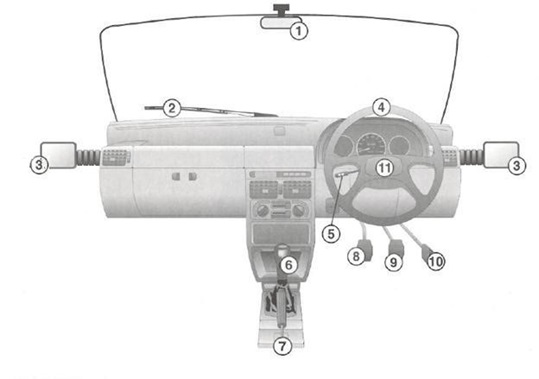
The vehicle controls section has 8 questions in the real test, and you need 6 right. Every question refers to the numbered diagram below, so learn the numbers: 1 rear-view mirror, 2 wipers, 3 side mirrors, 4 steering wheel, 5 indicator, 6 gear lever, 7 parking brake, 8 clutch, 9 foot brake, 10 accelerator and 11 hooter.
Heavy vehicles use the same numbering.
The distance it takes the driver of a motor vehicle to stop is_____(i) longer on a wet road than a dry road (ii) longer if the vehicle is traveling at a higher speed. (iii) longer if the vehicle is loaded.
- (i) only is correct.
- (ii) only is correct.
- (iii) only is correct.
- All of the above are correct
Show the answer
Answer: D. All of the above are correct
Stopping distance grows with each of these. A wet road gives the tyres less grip, a higher speed means you cover more ground while you react and brake, and a loaded vehicle is heavier, so it needs longer to stop.
What controls must you use when you are going to turn sharp
(i) 1,3,5,6 and 8 only.(ii) 3,4,5,9 and 10 only.(iii) 1,3,4,5,6,8,9 and 10 only.
- (i) only is correct.
- (ii) only is correct.
- (iii) only is correct.
- All of the above are correct
Show the answer
Answer: C. (iii) only is correct.
For a sharp turn you check your mirrors (1 and 3), signal with the indicator (5), ease off the accelerator (10) and brake (9), use the clutch (8) and gear lever (6) to change down, and steer (4). That is 1, 3, 4, 5, 6, 8, 9 and 10.
To accelerate your vehicle you must use number
(i) 6.(ii) 8.(iii) 10.
- (i) only is correct.
- (ii) only is correct.
- (iii) only is correct.
- All of the above are correct
Show the answer
Answer: C. (iii) only is correct.
Number 10 is the accelerator, the right-hand pedal. Pressing it increases the engine speed and makes the vehicle go faster.
To ensure that your parked vehicle, does not move you must use number
(i) 7.(ii) 8.(iii) 9.
- (i) only is correct.
- (ii) only is correct.
- (iii) only is correct.
- All of the above are correct
Show the answer
Answer: A. (i) only is correct.
Number 7 is the parking (hand) brake. Pull it up whenever you park so the vehicle cannot roll away. The foot brake only holds the vehicle while your foot is on it.
To turn number ... is used
(i) 4.(ii) 5.(iii) 10.
- (i) only is correct.
- (ii) only is correct.
- (iii) only is correct.
- All of the above are correct
Show the answer
Answer: A. (i) only is correct.
Number 4 is the steering wheel. It is the control that changes the direction the vehicle travels in.
Number ...is not found in an automatic vehicle
(i) 2.(ii) 6.(iii) 8.
- (i) only is correct.
- (ii) only is correct.
- (iii) only is correct.
- None of the above are correct
Show the answer
Answer: C. (iii) only is correct.
Number 8 is the clutch pedal. An automatic gearbox changes gear by itself, so an automatic vehicle has no clutch pedal.
To stop your vehicle, you must use number...
(i) 9.(ii) 8.(iii) 7.
- (i) only is correct.
- (ii) only is correct.
- (iii) only is correct.
- All of the above are correct
Show the answer
Answer: A. (i) only is correct.
Number 9 is the foot brake, the middle pedal. It slows the vehicle down and brings it to a standstill.
To select a gear you must use numbers...
(i) 7 and 8.(ii) 5 and 8.(iii) 6 and 8.
- (i) only is correct.
- (ii) only is correct.
- (iii) only is correct.
- None of the above are correct
Show the answer
Answer: C. (iii) only is correct.
To change gear you press the clutch (8) to disconnect the engine from the gearbox, then move the gear lever (6) to the gear you want.
The … is not found in an automatic vehicle
- 8
- 5
- 3
Show the answer
Answer: A. 8
Number 8 is the clutch pedal. An automatic gearbox changes gear by itself, so an automatic vehicle has no clutch pedal.
The … is the control you would use to check the right hand rear-side of your vehicle
- 5
- 3
- 10
Show the answer
Answer: B. 3
Number 3 is the side (exterior) mirrors. The right-hand mirror shows what is behind you on the right, including vehicles about to overtake you.
Which control is used to accelerate your vehicle?
- 3
- 7
- 10
Show the answer
Answer: C. 10
Number 10 is the accelerator, the right-hand pedal. Pressing it increases the engine speed and makes the vehicle go faster.
Which control is used to ensure that your parked vehicle does not move?
- 7
- 1
- 9
Show the answer
Answer: A. 7
Number 7 is the parking (hand) brake. Pull it up whenever you park so the vehicle cannot roll away. The foot brake only holds the vehicle while your foot is on it.
To change gears which controls are used?
- 8 and 10
- 8 and 6
- 8 and 7
Show the answer
Answer: B. 8 and 6
To change gear you press the clutch (8) to disconnect the engine from the gearbox, then move the gear lever (6) to the gear you want.
Which control is used to stop your vehicle?
- 5
- 11
- 9
Show the answer
Answer: C. 9
Number 9 is the foot brake, the middle pedal. It slows the vehicle down and brings it to a standstill.
When brakes are applied, the distance it takes to stop your vehicle is
(i) longer if carrying a passenger. (ii) longer on a wet surface. (iii) longer if driving at a higher speed.
- (i)
- (ii) and (iii)
- (i), (ii) and (iii)
Show the answer
Answer: C. (i), (ii) and (iii)
Anything that adds weight (a passenger), reduces grip (a wet surface) or adds speed makes the stopping distance longer, so all three are true.
Which control helps the driver when engaging or disengaging a gear?
- 10
- 8
- 9
Show the answer
Answer: B. 8
Number 8 is the clutch. Pressing it disconnects the engine from the gearbox, so you can engage or disengage a gear smoothly.
The … control increases the vehicle speed
- 1
- 9
- 10
Show the answer
Answer: C. 10
Number 10 is the accelerator, the right-hand pedal. Pressing it increases the engine speed and makes the vehicle go faster.
The … warns other road users of your intention to steer to the right or left, or turn to the right or left
- 5
- 7
- 11
Show the answer
Answer: A. 5
Number 5 is the indicator lever. It flashes your indicators to tell other road users that you are about to turn or change direction.
Which control is used to alert other road users so to avoid accidents?
- 3
- 11
- 8
Show the answer
Answer: B. 11
Number 11 is the hooter. Use it to warn other road users of danger and help avoid a collision, never to show frustration.
The … is used to avoid stalling before a complete standstill
- 5
- 10
- 8
Show the answer
Answer: C. 8
Number 8 is the clutch. Pressing it just before the vehicle stops disconnects the engine from the wheels, so the engine does not stall.
Which control is used to clean your vehicle windscreen?
- 2
- 3
- 6
Show the answer
Answer: A. 2
Number 2 is the windscreen wipers. Use them to clear rain and dirt from the windscreen so you can see properly.
Which control should assist the driver to change gears?
- 8
- 9
- 10
Show the answer
Answer: A. 8
Number 8 is the clutch. Pressing it disconnects the engine from the gearbox, so you can engage or disengage a gear smoothly.
Which control helps to change the direction of the vehicle
- 5
- 4
- 2
Show the answer
Answer: B. 4
Number 4 is the steering wheel. It is the control that changes the direction the vehicle travels in.
Use … to keep your vehicle stationary after parking
- 7
- 5
- 2
Show the answer
Answer: A. 7
Number 7 is the parking (hand) brake. Pull it up whenever you park so the vehicle cannot roll away. The foot brake only holds the vehicle while your foot is on it.
Which control is used when driving in rainy weather?
- 6
- 2
- 4
Show the answer
Answer: B. 2
Number 2 is the windscreen wipers. Use them to clear rain and dirt from the windscreen so you can see properly.
To decrease speed use …
- 4
- 9
- 7
Show the answer
Answer: B. 9
Number 9 is the foot brake, the middle pedal. It slows the vehicle down and brings it to a standstill.
Which control to use when you want to stop on a steep incline and preventing the vehicle to start rolling backwards?
- 7
- 8
- 9
Show the answer
Answer: A. 7
Number 7 is the parking (hand) brake. On a steep incline it holds the vehicle still, so it cannot roll backwards while you move your foot from the brake to the accelerator.
The … are the control you would use to check the side of your vehicle and the rear-side of your vehicle
- 10
- 3 and 1
- 5
Show the answer
Answer: B. 3 and 1
Number 1 is the interior rear-view mirror, which shows what is directly behind you, and number 3 is the side mirrors, which show the sides and rear. Together they give you the full picture behind you.
To turn a sharp curve on the road, you must use …
- 2, 6, 8 and 9
- 1, 3, 4, 6, 7, 9 and 10 only
- 1, 3, 4, 6, 8, 9 and 10 only
Show the answer
Answer: C. 1, 3, 4, 6, 8, 9 and 10 only
For a sharp curve in the road you check your mirrors (1 and 3), ease off the accelerator (10) and brake (9) before the curve, use the clutch (8) and gear lever (6) to change down, and steer (4) through it. You do not signal for a bend in the road, so the indicator (5) is not used.
Which control is not found in an automatic vehicle?
- 8.
- 5.
- 3.
Show the answer
Answer: A. 8.
Number 8 is the clutch pedal. An automatic gearbox changes gear by itself, so an automatic vehicle has no clutch pedal.
Which control would you use to look what is on the right hand rear-side of your vehicle
- 3.
- 5.
- 10.
Show the answer
Answer: A. 3.
Number 3 is the side (exterior) mirrors. The right-hand mirror shows what is behind you on the right, including vehicles about to overtake you.
What control is used to ensure that your parked vehicle does not move?
- 7.
- 3.
- 6.
Show the answer
Answer: A. 7.
Number 7 is the parking (hand) brake. Pull it up whenever you park so the vehicle cannot roll away. The foot brake only holds the vehicle while your foot is on it.
In order to change a gear, you must use control/s?
- 8 and 10.
- 8 and 7.
- 8 and 6.
Show the answer
Answer: C. 8 and 6.
To change gear you press the clutch (8) to disconnect the engine from the gearbox, then move the gear lever (6) to the gear you want.
To stop your vehicle you must use number ?
- 9.
- 8.
- 10.
Show the answer
Answer: A. 9.
Number 9 is the foot brake, the middle pedal. It slows the vehicle down and brings it to a standstill.
The control that assists the driver when engaging or disengaging a gear is?
- 10.
- 7.
- 8.
Show the answer
Answer: C. 8.
Number 8 is the clutch. Pressing it disconnects the engine from the gearbox, so you can engage or disengage a gear smoothly.
The speed of the vehicle can be increased by control?
- 10.
- 9.
- 8.
Show the answer
Answer: A. 10.
Number 10 is the accelerator, the right-hand pedal. Pressing it increases the engine speed and makes the vehicle go faster.
Which control is used before applying the brake in order to slow down or stop.
- 1.
- 8.
- 10.
Show the answer
Answer: A. 1.
Before you brake, check your rear-view mirror (number 1) so you know what is behind you. Braking suddenly without checking can get you hit from behind.
Which control is used before changing direction of a vehicle?
- 5.
- 9.
- 8.
Show the answer
Answer: A. 5.
Before you change direction you must signal your intention, and number 5, the indicator lever, is the control that does this.
Which control is used before changing the speed of the vehicle?
- 9.
- 10.
- 1.
Show the answer
Answer: C. 1.
Before you change speed, check your rear-view mirror (number 1) to see whether traffic behind you is close enough to be affected.
Which control is used to advise other road users of your intention to steer to the left or right, or to turn to the left or right.
- 3.
- 8.
- 5.
Show the answer
Answer: C. 5.
Number 5 is the indicator lever. It flashes your indicators to tell other road users that you are about to turn or change direction.
The following control is used to alert other road users in order to avoid a collision?
- 11.
- 7.
- 4.
Show the answer
Answer: A. 11.
Number 11 is the hooter. Use it to warn other road users of danger and help avoid a collision, never to show frustration.
Which control is used to avoid the vehicle stalling just before coming to a complete standstill?
- 7.
- 8.
- 10.
Show the answer
Answer: B. 8.
Number 8 is the clutch. Pressing it just before the vehicle stops disconnects the engine from the wheels, so the engine does not stall.
In order to bring the vehicle to a complete standstill, what control is used?
- 3.
- 4.
- 9.
Show the answer
Answer: C. 9.
Number 9 is the foot brake, the middle pedal. It slows the vehicle down and brings it to a standstill.
Which control is used to change the direction of the vehicle?
- 4.
- 2.
- 8.
Show the answer
Answer: A. 4.
Number 4 is the steering wheel. It is the control that changes the direction the vehicle travels in.
Which control is used to clean the front windscreen of the vehicle?
- 2.
- 3.
- 4.
Show the answer
Answer: A. 2.
Number 2 is the windscreen wipers. Use them to clear rain and dirt from the windscreen so you can see properly.
Which controls must be used in combination immediately before coming to a standstill?
- 8, 6 and 9.
- 2 , 6 and 7.
- 2 , 5 and 1.
Show the answer
Answer: A. 8, 6 and 9.
Just before you stop, press the clutch (8) so the engine does not stall, select neutral with the gear lever (6), and keep braking with the foot brake (9) until the vehicle is still.
Which control is used to decrease speed or stop?
- 7.
- 8.
- 9.
Show the answer
Answer: C. 9.
Number 9 is the foot brake, the middle pedal. It slows the vehicle down and brings it to a standstill.
Which control is used to keep the vehicle stationary after parking?
- 6.
- 9.
- 7.
Show the answer
Answer: C. 7.
Number 7 is the parking (hand) brake. Pull it up whenever you park so the vehicle cannot roll away. The foot brake only holds the vehicle while your foot is on it.
Which control is used to see what is to the rear of the vehicle?
- 1.
- 2.
- 11.
Show the answer
Answer: A. 1.
Number 1 is the interior rear-view mirror. It shows you what is directly behind your vehicle.
Which control is used to select a gear?
- 7.
- 6.
- 8.
Show the answer
Answer: B. 6.
Number 6 is the gear lever. You move it to select the gear you need, with the clutch pressed in.
The control used to steer the vehicle to the left or right is?
- 3.
- 5.
- 4.
Show the answer
Answer: C. 4.
Number 4 is the steering wheel. It is the control that changes the direction the vehicle travels in.
The following control is used to turn?
- 4.
- 7.
- 3.
Show the answer
Answer: A. 4.
Number 4 is the steering wheel. It is the control that changes the direction the vehicle travels in.
When driving in the rain the following control is used?
- 2.
- 4.
- 3.
Show the answer
Answer: A. 2.
Number 2 is the windscreen wipers. Use them to clear rain and dirt from the windscreen so you can see properly.
Which control(s) is/are used to see what is to the rear and sides of the vehicle?
- 1 and 3.
- 1 and 11.
- 2 and 3.
Show the answer
Answer: A. 1 and 3.
Number 1 is the interior rear-view mirror, which shows what is directly behind you, and number 3 is the side mirrors, which show the sides and rear. Together they give you the full picture behind you.
Which control(s) is/are used when changing from one gear to another?
- 10 and 6.
- 8 and 7.
- 8 and 6.
Show the answer
Answer: C. 8 and 6.
To change gear you press the clutch (8) to disconnect the engine from the gearbox, then move the gear lever (6) to the gear you want.
Which controls must you use when there is a sharp turn in the road?
- 7, 2, 6, 8, 9 and 10.
- 6, 8, 9 and 10.
- 1, 4, 6, 8, 9 and 10.
Show the answer
Answer: C. 1, 4, 6, 8, 9 and 10.
For a sharp curve in the road you check your mirrors (1 and 3), ease off the accelerator (10) and brake (9) before the curve, use the clutch (8) and gear lever (6) to change down, and steer (4) through it. You do not signal for a bend in the road, so the indicator (5) is not used.
The following control is used to accelerate your vehicle?
- 8.
- 9.
- 10.
Show the answer
Answer: C. 10.
Number 10 is the accelerator, the right-hand pedal. Pressing it increases the engine speed and makes the vehicle go faster.
The control that must be used to ensure the vehicle remains stationary is?
- 7.
- 6.
- 9.
Show the answer
Answer: A. 7.
Number 7 is the parking (hand) brake. Pull it up whenever you park so the vehicle cannot roll away. The foot brake only holds the vehicle while your foot is on it.
Which foot should you use to operate the clutch?
- The right foot
- The left foot
- Either foot
Show the answer
Answer: B. The left foot
In a manual vehicle the left foot works the clutch only; the right foot works the brake and accelerator.
What is the 'biting point' of the clutch?
- The highest gear
- The point where the brakes lock
- The point where the clutch starts to connect the engine to the wheels
Show the answer
Answer: C. The point where the clutch starts to connect the engine to the wheels
At the biting point the engine starts to drive the wheels. You hold it there when pulling away and on hills.
Why do you press the clutch down just before the vehicle stops?
- To prevent the engine from stalling
- To make the vehicle stop faster
- To switch off the engine
Show the answer
Answer: A. To prevent the engine from stalling
Disengaging the clutch just before stopping keeps the engine running. Brake first, so you do not coast.
'Coasting' means…
- Driving downhill in a low gear
- Driving with the clutch pressed in or the gear lever in neutral
- Driving at a constant speed
Show the answer
Answer: B. Driving with the clutch pressed in or the gear lever in neutral
Coasting reduces your control of the vehicle and is penalised on the driving test.
Before starting the engine of a manual vehicle, the gear lever should be in…
- First gear
- Reverse
- Neutral
Show the answer
Answer: C. Neutral
Starting in neutral, with the parking brake on and the clutch down, stops the vehicle jumping forward.
On an uphill start, which control holds the vehicle while you find the biting point?
- The parking brake
- The hooter
- The accelerator
Show the answer
Answer: A. The parking brake
Hold the vehicle on the parking brake, find the biting point, then release the brake as you move off.