Pedestrians are the most vulnerable road users, and the exam tests whether you protect them. Give way to pedestrians on your half of a pedestrian crossing and to people already crossing the road you are turning into.
Never overtake a vehicle stopped at a crossing, and do not stop within 9 m of the approach side of one.
You may not overtake a vehicle stopped at a pedestrian crossing:
- False, only if there are pedestrians present
- False
- True
- None of the above
Show the answer
Answer: C. True
Never overtake a vehicle that has stopped at a pedestrian crossing: it may have stopped for a pedestrian you cannot see.
How close to a pedestrian crossing may you stop?
- Not closer than 5 m of the white line
- Not closer than 9 m of the approach side
- Not closer than 5 m of the approach side
- Not closer than 9 m of the white line
Show the answer
Answer: B. Not closer than 9 m of the approach side
You may not stop within 9 m of the approach side of a pedestrian crossing, so drivers and pedestrians can see each other clearly.
How close to a pedestrian crossing may you stop?
- Not within 8 metres of the approach side
- Not within 1 metre of the approach side
- Not within 9 metres of the approach side
- Not within 3 metres of the approach side
Show the answer
Answer: C. Not within 9 metres of the approach side
You may not stop within 9 m of the approach side of a pedestrian crossing, so drivers and pedestrians can see each other clearly.
When approaching a pedestrian crossing, you should:
- Stop and wait for a crossing-guard to signal you to continue
- Slow down, wait for pedestrians to cross, then proceed cautiously
- Ignore it and keep driving if there is no sign of pedestrians
- None of the above
Show the answer
Answer: B. Slow down, wait for pedestrians to cross, then proceed cautiously
At a pedestrian crossing, slow down, let pedestrians cross, then carry on carefully.
You may not overtake:
(i) a vehicle that has stopped at a pedestrian crossing(ii) where your view of the road ahead is restricted by the crest of a hill or a curve(iii) both of these
- (i) only is correct
- (ii) only is correct
- (iii) only is correct
- All of the above are correct
Show the answer
Answer: C. (iii) only is correct
Never overtake a vehicle that has stopped at a pedestrian crossing, or when a hill crest or curve blocks your view ahead. Both are correct.
At an intersection:
(i) you must yield to oncoming traffic if you want to turn right (ii) vehicles have the right of way over pedestrians (iii) you can use a stop sign as a yield sign if there is no other traffic
- (i) only is correct
- (ii) only is correct
- (iii) only is correct
- All of the above are correct
Show the answer
Answer: A. (i) only is correct
When turning right you yield to oncoming traffic. Pedestrians do not lose right of way to vehicles, and a stop sign always means stop, even when the road is empty.
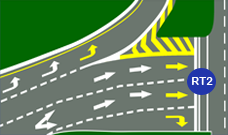
Road marking RT2 in the sketch below
(i) Show you that you may not stop further than the front one of the two.(ii) Are lines where pedestrians walk.(iii) Are lines that indicate another traffic line.

- (i) only is correct.
- (ii) only is correct.
- (iii) only is correct.
- All of the above are correct
Show the answer
Answer: B. (ii) only is correct.
These markings show a pedestrian crossing: the lines between which pedestrians walk across the road.
Where may you legally stop with your vehicle
(i) 4m from a tunnel.(ii) 5m from a pedestrian crossing.(iii) 6m from a railway crossing.
- (i) and (iii) are correct.
- (ii) and (iii) are correct.
- (iii) only is correct.
- None of the above are correct
Show the answer
Answer: C. (iii) only is correct.
Of these, only 6 m from a railway crossing is outside the no-stopping zone. 4 m from a tunnel and 5 m from a pedestrian crossing are both too close.
You must give way to pedestrians:
(i) who need to cross the freeway(ii) who are approaching your half of a pedestrian crossing(iii) both of these
- (i) only is correct
- (ii) only is correct
- (iii) only is correct
- All of the above are correct
Show the answer
Answer: B. (ii) only is correct
You must give way to pedestrians approaching your half of a pedestrian crossing. Pedestrians are not allowed on a freeway at all.
At an intersection:
(i) You must yield to oncoming traffic if you want to turn right. (ii) Vehicles have right of way over pedestrians. (iii) You can use a stop sign as a yield sign if there is no other traffic.
- (i) and (iii).
- (i) only is correct.
- (i), (ii) and (iii) are correct.
- None of the above are correct
Show the answer
Answer: B. (i) only is correct.
When turning right you must yield to oncoming traffic. Pedestrians do not lose right of way to vehicles, and you must always stop at a stop sign.
When approaching an intersection you must stop if:
(i) the light is amber and you can stop before the line (ii) the flashing green filter light is on for you to turn right (iii) if the light is green but a pedestrian wants to cross in front of you
- (i) only is correct
- (ii) only is correct
- (iii) only is correct
- All of the above are correct
Show the answer
Answer: A. (i) only is correct
If the light turns amber and you can still stop safely before the line, you must stop. A flashing green arrow means you may turn.
Pedestrians must cross a roadway only at a pedestrian crossing or an intersection or at a distance further than … from such pedestrian crossing or intersection
- 9m
- 12m
- 50m
Show the answer
Answer: C. 50m
Pedestrians must cross at a pedestrian crossing or intersection, or more than 50 m away from one.
When is it compulsory to stop?
(i) At the request or on the signal of a person leading or driving any bovine animal, horse, ass, mule, sheep. (ii) Goat, pig or ostrich on such road. (iii) When pedestrians want to cross a blocked pedestrian crossing.
- Only (i) is correct
- (i) and (iii) only are correct
- All of the above are correct
Show the answer
Answer: C. All of the above are correct
You must stop when signalled by a person leading or driving livestock such as cattle, horses, sheep, goats, pigs or ostriches, and for pedestrians at a crossing. All three are correct.
When pedestrians are already crossing the road into which you are turning left, you must …
- Continue driving as itu2019s your right of way
- Sound your horn to warn them of your presence
- Wait and allow them to cross the road
Show the answer
Answer: C. Wait and allow them to cross the road
Pedestrians already crossing the road you are turning into have right of way. Wait for them to finish crossing.
You may not overtake a vehicle stopped at a pedestrian crossing.
- Only if there are no pedestrian present.
- False
- True.
Show the answer
Answer: C. True.
True: never overtake a vehicle stopped at a pedestrian crossing, because it may have stopped for a pedestrian you cannot see.
How close to a demarcated pedestrian crossing may you stop?
- There is no stopping distance, as long as you do not stop on the actual pedestrian crossing.
- Not within 9 m of the white line.
- Not within 9 m of your approaching side.
Show the answer
Answer: C. Not within 9 m of your approaching side.
You may not stop within 9 m of the approach side of a pedestrian crossing.
When is it compulsory to stop?
(i) In compliance with any direction conveyed by a road traffic sign or given by a traffic officer in uniform. (ii) At the request or on the signal of a person leading or driving any bovine animal, horse, sheep, goat, cattle, etc on such road. (iii) When pedestrians want to cross a blocked pedestrian crossing.
- All of the above are correct.
- (i) Only is correct.
- (ii) and (iii) Only are correct.
Show the answer
Answer: A. All of the above are correct.
You must stop when a road traffic sign or uniformed traffic officer directs you to, when signalled by a person driving livestock, and for pedestrians at a crossing. All three are correct.
When must you give way to pedestrians?
- Freeway.
- Railway crossing.
- Pedestrian crossing.
Show the answer
Answer: C. Pedestrian crossing.
You must give way to pedestrians at a pedestrian crossing.
How close to a pedestrian crossing may you stop?
- Not closer than 5 m of the white line.
- Not closer than 9 m of the approach side
- Not closer than 9 m of the white line.
Show the answer
Answer: B. Not closer than 9 m of the approach side
You may not stop within 9 m of the approach side of a pedestrian crossing.
Which of the following are not allowed on a freeway?
(i) Pedestrians. (ii) Hand signals. (iii) Motor tricycles.
- Only (i) and (ii) are correct.
- All of the above are correct.
- Only (ii) and (iii) are correct.
Show the answer
Answer: B. All of the above are correct.
Pedestrians, hand signals and motor tricycles are all not allowed on a freeway in normal circumstances.
You may not park your vehicle on the roadway of a public road within an urban area
(i) on a pedestrian mall (ii) on a pedestrian lane (iii) on a traffic island.
- (i) and (ii) are correct.
- (iii) only is correct.
- All of the above.
Show the answer
Answer: C. All of the above.
In an urban area you may not park on a pedestrian mall, a pedestrian lane or a traffic island. All three are correct.
Your vehicle's headlights must be switched on....
(i) At anytime of the day when you cannot see pedestrians and vehicles from 150m in front of you.(ii) From sunset to sunrise.(iii) When it rains and you cannot see vehicles from 100m in front of you.
- (ii) Only is correct
- (i) and (ii) only are correct
- All of the above are correct
Show the answer
Answer: C. All of the above are correct
Headlights must be on from sunset to sunrise, and whenever you cannot see clearly 150 m ahead, including in rain. All three are correct.
Children are leaving a school as you drive past. You should…
- Keep to the speed limit and drive normally
- Slow down and watch for children stepping out
- Hoot to warn them
Show the answer
Answer: B. Slow down and watch for children stepping out
Children can run into the road without looking, often from between parked cars. Slow down and be ready to stop.
A scholar patrol holds up a stop sign. You must…
- Slow down
- Stop and wait until you are signalled to go
- Carry on if no child is on the crossing yet
Show the answer
Answer: B. Stop and wait until you are signalled to go
When a scholar patrol shows a stop sign, you must stop and wait until they let you go.
Where do pedestrians have right of way over vehicles?
- On, or approaching, your half of a pedestrian crossing
- Anywhere on the road
- Nowhere: vehicles always have right of way
Show the answer
Answer: A. On, or approaching, your half of a pedestrian crossing
You must give way to pedestrians on or approaching your half of a pedestrian crossing.
You see children playing next to the road. You should…
- Hoot and keep your speed
- Flash your headlights
- Slow down and be ready to stop
Show the answer
Answer: C. Slow down and be ready to stop
Children can run into the road without warning. Slow down and be ready to stop.
A pedestrian is crossing the road you are turning into. You should…
- Give way to the pedestrian
- Hoot to warn them
- Turn quickly before they reach your lane
Show the answer
Answer: A. Give way to the pedestrian
Give way to pedestrians crossing the road you are turning into.
At night, which pedestrians are hardest to see?
- Those carrying torches
- Those wearing dark clothing
- Those on the sidewalk
Show the answer
Answer: B. Those wearing dark clothing
Dark clothing makes pedestrians very hard to see at night. Drive at a speed that lets you stop in the distance you can see.
A vehicle has stopped at a pedestrian crossing in the lane next to you. You should…
- Overtake it carefully
- Hoot and pass
- Slow down and be ready to stop, because a pedestrian may be crossing
Show the answer
Answer: C. Slow down and be ready to stop, because a pedestrian may be crossing
A stopped vehicle can hide a pedestrian who is crossing. Never pass a vehicle stopped at a crossing.