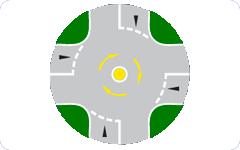
Most right-of-way questions come down to a few rules. At a four-way stop, vehicles go in the order they stopped. At a traffic circle, yield to traffic coming from your right. When turning right, yield to oncoming traffic.
And never enter an intersection unless you can get all the way through it: if there is not enough space, wait, even on green.
When do you have the right of way?
- When you have stopped first at a 4 way stop
- When you want to turn right at an intersection in a two-way road
- When you are within a traffic circle
- A and C above
Show the answer
Answer: D. A and C above
You have right of way at a four-way stop if you stopped first, and inside a traffic circle over vehicles waiting to enter. Turning right does not give you right of way: you must yield to oncoming traffic.
You may not drive into an intersection when:
- There is only enough space for a single vehicle
- The vehicle in front of you wants to turn right
- There is not enough space in the intersection to turn right without blocking other traffic
- None of the above
Show the answer
Answer: C. There is not enough space in the intersection to turn right without blocking other traffic
Never enter an intersection unless you can get all the way through it. If there is not enough space to complete your right turn, waiting in the intersection would block other traffic.
You should not enter an intersection if your vehicle is likely to block traffic:
- Only if it is an emergency
- True
- False
- None of the above
Show the answer
Answer: B. True
Never enter an intersection if you might get stuck in it and block cross traffic.
When arriving at a traffic circle:
- Vehicles in the circle already, have right of way
- Vehicles on your left, have right of way
- Vehicles on your right, have right of way
- A and C above
Show the answer
Answer: D. A and C above
At a traffic circle, vehicles already in the circle have right of way, and you give way to traffic on your right.
When approaching a four-way stop:
- Stop if you feel it is necessary
- The first vehicle to stop, should be the first to proceed, if safe to do so
- The person who indicates first, should be the first to proceed
- Slow your vehicle down and if safe to do so proceed
Show the answer
Answer: B. The first vehicle to stop, should be the first to proceed, if safe to do so
At a four-way stop, the vehicle that stopped first goes first, as long as it is safe. Signalling first does not give you priority.
When approaching an intersection and you wish to turn left or right:
- You should slow down, and indicate in a timely manner
- You should maintain your current speed and then turn in your chosen direction
- You should observe your surrounding traffic, ensuring safe passage, then proceed
- A and C
Show the answer
Answer: D. A and C
Approaching an intersection to turn, slow down and signal in good time, then watch the traffic around you and turn only when it is safe.
When turning at an intersection:
- You must yield to oncoming traffic if you want to turn right
- You have the right of way when turning right
- You are required to stop even if the flashing green arrow is pointing right
- You may overtake another vehicle when turning right
Show the answer
Answer: A. You must yield to oncoming traffic if you want to turn right
When you turn right at an intersection, you must yield to oncoming traffic that is going straight or turning left.
At an intersection:
(i) you must yield to oncoming traffic if you want to turn right (ii) vehicles have the right of way over pedestrians (iii) you can use a stop sign as a yield sign if there is no other traffic
- (i) only is correct
- (ii) only is correct
- (iii) only is correct
- All of the above are correct
Show the answer
Answer: A. (i) only is correct
When turning right you yield to oncoming traffic. Pedestrians do not lose right of way to vehicles, and a stop sign always means stop, even when the road is empty.
If you are driving towards a mini-circle and there are also vehicles from the other three sides you:
(i) Must always wait for the vehicle from your right before you drive on. (ii) May drive on if you were the first vehicle over the line. (iii) Must stop with all the vehicles and only drive on when it is save.

- (i) only is correct.
- (ii) only is correct.
- (iii) only is correct.
- All of the above are correct
Show the answer
Answer: B. (ii) only is correct.
At a mini-circle, the vehicle that reaches the line first may go first, as long as it is safe.
If you come across an emergency vehicle on the road sounding a siren you must:
(i) Flash your headlight to warn other traffic.(ii) Give right of way to emergency vehicle.(iii) Switch on your vehicles emergency light and blow your hooter.
- (ii) only is correct.
- (i) and (iii) are correct.
- (iii) and (iii) are correct.
- All of the above are correct
Show the answer
Answer: A. (ii) only is correct.
Give right of way to an emergency vehicle using its siren. Flashing your lights, hooting or switching on your hazards does not help.
At an intersection:
(i) You must yield to oncoming traffic if you want to turn right. (ii) Vehicles have right of way over pedestrians. (iii) You can use a stop sign as a yield sign if there is no other traffic.
- (i) and (iii).
- (i) only is correct.
- (i), (ii) and (iii) are correct.
- None of the above are correct
Show the answer
Answer: B. (i) only is correct.
When turning right you must yield to oncoming traffic. Pedestrians do not lose right of way to vehicles, and you must always stop at a stop sign.
When do you have the right of way?
(i) When you are within a traffic circle.(ii) When you have stopped first at a four-way stop.(iii) When you want to turn right at an intersection in a two-way stop intersection.
- (ii) and (iii) are correct.
- (i) only is correct.
- (i) and (ii) are correct.
- All of the above are correct
Show the answer
Answer: C. (i) and (ii) are correct.
You have right of way inside a traffic circle and when you stopped first at a four-way stop. When turning right you must yield to oncoming traffic.
When approaching an intersection you must stop if:
(i) the light is amber and you can stop before the line (ii) the flashing green filter light is on for you to turn right (iii) if the light is green but a pedestrian wants to cross in front of you
- (i) only is correct
- (ii) only is correct
- (iii) only is correct
- All of the above are correct
Show the answer
Answer: A. (i) only is correct
If the light turns amber and you can still stop safely before the line, you must stop. A flashing green arrow means you may turn.
Emergency vehicles sounding a bell, siren or warning device must be given right of way:
(i) at all times (ii) on a single-carriage freeway (iii) on a dual-carriage freeway
- (i) only is correct
- (ii) only is correct
- (iii) only is correct
- All of the above are correct
Show the answer
Answer: A. (i) only is correct
Emergency vehicles sounding a siren or other warning device must be given right of way at all times, on any road.
When turning at an intersection:
(i) you must signal as you turn (ii) you must signal before you turn (iii) you do not need to signal if you are turning left
- (i) only is correct
- (ii) only is correct
- (iii) only is correct
- All of the above are correct
Show the answer
Answer: B. (ii) only is correct
Signal before you turn, not while you are already turning, and always signal, even when turning left.
At a four-way stop:
(i) you may pass through the intersection without stopping if no other vehicles are present (ii) you must stop and drive off only when it is your turn (iii) both of these
- (i) only is correct
- (iii) only is correct
- (ii) only is correct
- All of the above are correct
Show the answer
Answer: C. (ii) only is correct
At a four-way stop you must always stop, even if no other vehicle is there, and drive off only when it is your turn.
You may use a mobile phone while driving:
(i) if it is held in your hand and you are stationary at an intersection (ii) if it is not being held in your hand or any other part of your body (iii) both of these
- (i) only is correct
- (ii) only is correct
- (iii) only is correct
- None of the above are correct
Show the answer
Answer: B. (ii) only is correct
You may only use a phone while driving if it is not held in your hand or any other part of your body, for example in a hands-free cradle. Holding it at a red light is still illegal.
You may NOT drive into an intersection when:
(i) The robot (traffic signal) is yellow and you are already in the intersection. (ii) The vehicle in front of you wants to turn right and the road is wide enough to pass on the left side. (iii) There is not enough space in the intersection to turn right without blocking other traffic.
- (iii) only is correct.
- (ii) ans (i) are correct.
- (ii) and (iii) are correct.
- None of the above are correct
Show the answer
Answer: A. (iii) only is correct.
Do not enter an intersection if there is not enough space to complete your right turn without blocking other traffic.
At a traffic circle:
(i) yield to vehicles coming from your right (ii) yield to vehicles coming from your left (iii) the same rules apply as with a 4-way stop
- (i) only is correct
- (ii) only is correct
- (iii) only is correct
- None of the above are correct
Show the answer
Answer: A. (i) only is correct
At a traffic circle, yield to vehicles coming from your right. It is not run like a four-way stop.
A flashing red robot means:
(i) you may pass through the intersection without stopping (ii) give way to vehicles to your left and right only (iii) consider the intersection a 4-way stop
- (i) only is correct
- (ii) only is correct
- (iii) only is correct
- All of the above are correct
Show the answer
Answer: C. (iii) only is correct
Treat a flashing red signal like a four-way stop: stop completely, then go in turn when it is safe.
Pedestrians must cross a roadway only at a pedestrian crossing or an intersection or at a distance further than … from such pedestrian crossing or intersection
- 9m
- 12m
- 50m
Show the answer
Answer: C. 50m
Pedestrians must cross at a pedestrian crossing or intersection, or more than 50 m away from one.
You are allowed to pass a vehicle on its left-hand side when it...
(i) is turning. (ii) indicates that it is going to turn right at an upcoming intersection. (iii) Drives in a town in the right-hand lane with two lanes in the same direction.
- (i) Only is correct.
- (i) and (iii) Ony are correct.
- (ii) and (iii) Only are correct.
Show the answer
Answer: C. (ii) and (iii) Only are correct.
You may pass on the left of a vehicle that has signalled it is turning right, or in town where there are two lanes in your direction.
You may not drive into an intersection when...
- There is not enough space in the intersection to turn right without blocking other traffic.
- There is only enough space for a single vehicle.
- The vehicle in front of you wants to turn right.
Show the answer
Answer: A. There is not enough space in the intersection to turn right without blocking other traffic.
Do not enter an intersection if there is not enough space to complete your right turn without blocking other traffic.
If you have a green light, but traffic is backed up into the intersection, you should..
- Wait until traffic clears before entering the intersection.
- Try to go around the traffic.
- Enter the intersection and hope traffic clears before the light changes.
Show the answer
Answer: A. Wait until traffic clears before entering the intersection.
Even on green, wait until there is room to get through. Entering a blocked intersection can leave you stuck across cross traffic.
When more than one vehicle is stopped at an intersection, which vehicle has a right of way?
- The vehicle that moves off the fastest..
- The vehicle on your right.
- Each vehicle in the order that they have stopped.
Show the answer
Answer: C. Each vehicle in the order that they have stopped.
When several vehicles are stopped at a four-way stop, they go in the order in which they stopped.
If you plan to enter into a driveway just after the intersection, when should you signal (indicate)?
- When you start to turn.
- After you cross the intersection.
- In the middle of the intersection.
Show the answer
Answer: B. After you cross the intersection.
If your driveway is just after an intersection, signal once you have crossed the intersection. Signalling earlier would make others think you are turning at the intersection.
When approaching an intersection with traffic signals (robots) that are out of order, you should...
- Treat it like a yield sign.
- Ignore it if you are driving on the road which has high priority.
- Treat it like a four-way stop intersection.
Show the answer
Answer: C. Treat it like a four-way stop intersection.
When traffic lights are out of order, treat the intersection as a four-way stop.
If you have already entered an intersection and the traffic light changes, you should...
- Sound your hooter through the intersection.
- Flash your lights through the intersection.
- Proceed and clear the intersection.
Show the answer
Answer: C. Proceed and clear the intersection.
If you are already in the intersection when the light changes, carry on and clear the intersection safely.
When may you legally block an intersection?
- When the light is amber.
- You may not block an intersection at any time.
- During rush hour traffic.
Show the answer
Answer: B. You may not block an intersection at any time.
You may never block an intersection.
At traffic circles, you must give way to...
- Traffic which will cross their yield line before you.
- Both A and C are correct.
- Traffic already in the circle, approaching from the right.
Show the answer
Answer: B. Both A and C are correct.
At a traffic circle, give way to traffic already in the circle coming from your right, and to traffic that will cross its yield line before you.
When turning right at an intersection...
(i) You may overtake another vehicle. (ii) You are required to stop even if there is a flashing green arrow pointing to the right. (iii) You have the right of way. (iv) You must yield to oncoming traffic
- Only (ii) and (iv) are correct
- All of the above are correct.
- (iv) Only is correct.
Show the answer
Answer: C. (iv) Only is correct.
When turning right you must yield to oncoming traffic. You do not have right of way, may not overtake while turning, and need not stop on a flashing green arrow.
At an intersection...
- You must yield to oncoming traffic if you want to turn right.
- Vehicles have the right of way over pedestrians..
- You can use a stop sign as a yield sign if there is no other traffic.
Show the answer
Answer: A. You must yield to oncoming traffic if you want to turn right.
When turning right at an intersection you must yield to oncoming traffic. A stop sign always means stop.
When approaching an intersection you must stop if...
- The light is green but a pedestrian wants to cross in front of you.
- The light is amber and you can stop before the line.
- The flashing green filter light is on for you to turn right.
Show the answer
Answer: B. The light is amber and you can stop before the line.
If the light turns amber and you can still stop safely before the line, you must stop.
When turning at an intersection...
- You must signal before you turn.
- You must signal as you turn.
- You do not need to signal if you are turning left.
Show the answer
Answer: A. You must signal before you turn.
Signal before you turn, not while turning, and always signal, even when turning left.
At a traffic circle...
- Yield to vehicles coming from your left.
- The same rule apply as with a 4-way stop.
- Yield to vehicles coming from your right.
Show the answer
Answer: C. Yield to vehicles coming from your right.
At a traffic circle, yield to vehicles coming from your right.
When turning at an intersection...
- You may overtake another vehicle when turning right.
- You have the right of way when turning right.
- You must yield to oncoming traffic if you want to turn right.
Show the answer
Answer: C. You must yield to oncoming traffic if you want to turn right.
When you turn right at an intersection, you must yield to oncoming traffic.
You are approaching an intersection and the traffic light turns amber (orange). You must..
- Hit the brakes hard and stop, even if you are going to stop over the stop line and pedestrian lines.
- Slow down and stop before the stop line, unless you cannot stop safely.
- Gear down and speed up to get across the intersection.
Show the answer
Answer: B. Slow down and stop before the stop line, unless you cannot stop safely.
When the light turns amber, slow down and stop before the stop line, unless you are too close to stop safely.
At a four-way stop...
- You must stop and drive off only when it is your turn.
- You may pass through the intersection without stopping if no other vehicles are present.
- Both A and B are correct.
Show the answer
Answer: A. You must stop and drive off only when it is your turn.
At a four-way stop you must always stop, and drive off only when it is your turn.
The driver/rider of a vehicle must yield right of way slow down or stop, if necessary in order to yield right of way to a....
- Vehicle in a mini-circle.
- Vehicle at an intersection
- Pedestrian crossing a roadway within a pedestrian crossing
Show the answer
Answer: C. Pedestrian crossing a roadway within a pedestrian crossing
You must yield to pedestrians crossing within a pedestrian crossing, slowing down or stopping if necessary.
When do you have the right of way?
(i) When you are within a traffic circle.(ii) When you have stopped first at a four-way stop.(iii) When you want to turn right at an intersection that has a two-way traffic.
- (i) and (ii) only are correct
- All of the above are correct
- (i) only is correct
Show the answer
Answer: A. (i) and (ii) only are correct
You have right of way inside a traffic circle and when you stopped first at a four-way stop. When turning right, you yield to oncoming traffic.
At a yield sign you must…
- Always stop
- Slow down and give way to traffic on the road you are entering, stopping if necessary
- Carry on without slowing
Show the answer
Answer: B. Slow down and give way to traffic on the road you are entering, stopping if necessary
A yield sign means give way. You only need to stop if traffic on the other road makes it necessary.
You reach a stop sign and there is no other traffic in sight. You…
- May roll through slowly
- Must stop completely
- May treat it as a yield sign
Show the answer
Answer: B. Must stop completely
A stop sign always means stop completely behind the line, even when the road is empty.
You want to turn right at a green traffic light, but there is oncoming traffic. You…
- Turn, because your light is green
- Yield to the oncoming traffic and turn when it is clear
- Hoot so they stop for you
Show the answer
Answer: B. Yield to the oncoming traffic and turn when it is clear
Green does not give you right of way over oncoming traffic when you turn right. Yield and turn when it is clear.
Where must you stop at a stop sign?
- Behind the stop line
- In the middle of the intersection
- Anywhere next to the sign
Show the answer
Answer: A. Behind the stop line
Stop behind the stop line, where you can see the traffic, then go when it is safe.