Stopping distance is how far you travel from the moment you see a hazard until the vehicle stops. It is longer when you are going faster, when the road is wet or slippery, and when the vehicle is loaded or carrying passengers.
These questions usually list several statements and ask which are true. In almost every version, the answer is that all of those factors increase the distance.
The distance it takes the driver of a motor vehicle to stop is:
(i) Longer on a wet road than on a dry road.(ii) Longer if the vehicle is traveling at a higher speed.(iii) Longer if the vehicle is loaded.
- (i) only is correct.
- (ii) only is correct.
- (iii) only is correct.
- All of the above are correct
Show the answer
Answer: D. All of the above are correct
Stopping distance grows with each of these. A wet road gives less grip, a higher speed covers more ground while you react and brake, and a loaded vehicle is heavier.
The distance it takes the driver of a motor vehicle to stop is
(i) Longer on a wet road than a dry road.(ii) Longer if the vehicle is traveling at a higher speed.(iii) Longer if the vehicle is loaded.
- (i) and (ii) are correct.
- (ii) and (iii) are correct.
- (iii) only is correct.
- All of the above are correct
Show the answer
Answer: D. All of the above are correct
Stopping distance grows with each of these. A wet road gives less grip, a higher speed covers more ground while you react and brake, and a loaded vehicle is heavier.
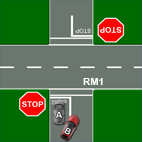
Look at the sketch, Vehicle B:
(i) Can drive past vehicle A if there are no other vehicles.(ii) Can drive over the stop line following vehicle A if there are no oncoming vehicles.(iii) Must stop behind vehicle A drive nearer if that vehicle has driven off, stop immediately behind the stop line and drive on when it is safe to do so.

- (i) only is correct.
- (ii) only is correct.
- (iii) only is correct.
- All of the above are correct
Show the answer
Answer: C. (iii) only is correct.
At a stop line you wait your turn: stop behind vehicle A, move up once it has gone, stop again at the stop line, and drive on only when it is safe.
The distance it takes you to stop your motorcycle is:
(i) Longer on a wet road than a dry road.(ii) longer if you ride at a higher speed.(iii) Longer if it is loaded.
- (i) only is correct.
- (iii) only is correct.
- (ii) and (iii) are correct.
- All of the above are correct
Show the answer
Answer: D. All of the above are correct
Stopping distance grows with each of these. A wet road gives less grip, a higher speed covers more ground while you react and brake, and a loaded motorcycle is heavier.
The distance it takes the driver of a motorcycle to stop is_____(i) longer on a wet road than a dry road (ii) longer if the vehicle is traveling at a higher speed. (iii) longer if the vehicle is loaded.
- (i) is correct
- (i) and (ii) are correct
- All of the above are correct
- None of the above are correct
Show the answer
Answer: C. All of the above are correct
Stopping distance grows with each of these. A wet road gives less grip, a higher speed covers more ground while you react and brake, and extra weight (a load or a passenger) takes longer to stop.
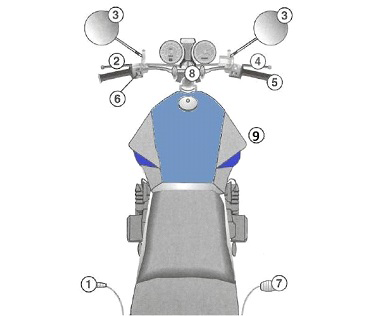
When 4 and 7 are used, the distance it takes for your motorcycle to stop is …
(i) longer if carrying a passenger. (ii) longer on a wet surface. (iii) longer if riding at a higher speed.
- (i) and (iii)
- (i), (ii) and (iii)
- (ii) and (iii)
Show the answer
Answer: B. (i), (ii) and (iii)
Stopping distance grows with each of these. A wet road gives less grip, a higher speed covers more ground while you react and brake, and extra weight (a load or a passenger) takes longer to stop.
The distance it takes the driver of a motor vehicle to stop is_____(i) longer on a wet road than a dry road (ii) longer if the vehicle is traveling at a higher speed. (iii) longer if the vehicle is loaded.
- (i) only is correct.
- (ii) only is correct.
- (iii) only is correct.
- All of the above are correct
Show the answer
Answer: D. All of the above are correct
Stopping distance grows with each of these. A wet road gives the tyres less grip, a higher speed means you cover more ground while you react and brake, and a loaded vehicle is heavier, so it needs longer to stop.
When brakes are applied, the distance it takes to stop your vehicle is
(i) longer if carrying a passenger. (ii) longer on a wet surface. (iii) longer if driving at a higher speed.
- (i)
- (ii) and (iii)
- (i), (ii) and (iii)
Show the answer
Answer: C. (i), (ii) and (iii)
Anything that adds weight (a passenger), reduces grip (a wet surface) or adds speed makes the stopping distance longer, so all three are true.
The distance it takes the driver of a vehicle to stop is...
(i) Longer on a wet road than on a dry road. (ii) Longer if the vehicle is travelling at a higher speed. (iii) Longer if the vehicle is loaded.
- All of the above are correct.
- (i) and (iii) Only are correct.
- (i) Only is correct
Show the answer
Answer: A. All of the above are correct.
Stopping distance grows with each of these. A wet road gives less grip, a higher speed covers more ground while you react and brake, and a loaded vehicle is heavier.
When you need to stop immediately:
(i) It takes longer if the vehicle is carrying a heavy load. (ii) It takes longer if the surface of the road is wet. (iii) It takes longer if the vehicle is travelling at a high speed. (iv) It takes longer if the driver is wearing shoes.
- All of the above are correct.
- (iii) and (iv) Only are correct.
- (i), (ii) and (iii) Only are correct.
Show the answer
Answer: C. (i), (ii) and (iii) Only are correct.
A heavy load, a wet road and a high speed all make the stopping distance longer. Wearing shoes does not.
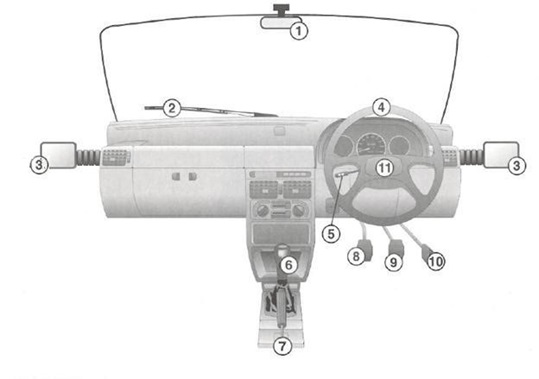
When control number 9 is used, the distance it takes the driver ofa motor vehicle to stop it is ...
(i) longer on a wet road than on a dry road.(ii) longer if the vehicle is travelling at a higher speed.(iii) longer if the vehicle is loaded.
- (i), (ii) and (iii).
- (ii) and (iii).
- (i) Only.
Show the answer
Answer: A. (i), (ii) and (iii).
Stopping distance grows with each of these. A wet road gives the tyres less grip, a higher speed means you cover more ground while you react and brake, and a loaded vehicle is heavier, so it needs longer to stop.
Your total stopping distance is made up of…
- Reaction distance plus braking distance
- Braking distance only
- Reaction time only
Show the answer
Answer: A. Reaction distance plus braking distance
You travel some distance while reacting, then more while braking. Together they make your stopping distance.
If you double your speed, your braking distance…
- Stays the same
- Roughly doubles
- Roughly quadruples
Show the answer
Answer: C. Roughly quadruples
Braking distance depends on the square of your speed, so twice the speed needs about four times the distance to brake.
Which of these makes your reaction distance longer?
- Being tired or distracted
- Driving on new tyres
- Driving on a dry road
Show the answer
Answer: A. Being tired or distracted
A slower reaction means you travel further before you even start braking. Tiredness and distraction slow your reactions.
Stopping distance is made up of…
- Following distance plus braking distance
- Braking distance only
- Reaction distance plus braking distance
Show the answer
Answer: C. Reaction distance plus braking distance
Stopping distance is the distance you travel while reacting plus the distance you travel while braking.
If you double your speed, your braking distance becomes about…
- Four times as long
- Twice as long
- The same
Show the answer
Answer: A. Four times as long
Braking distance increases with the square of your speed, so double the speed means about four times the braking distance.
Which of these increases your reaction distance?
- Driving a lighter car
- Being tired or distracted
- New tyres
Show the answer
Answer: B. Being tired or distracted
Tiredness, distraction, alcohol and drugs all slow your reactions, so you travel further before you even start braking.
On a wet road, your braking distance…
- Stays the same
- Decreases
- Increases
Show the answer
Answer: C. Increases
Wet roads reduce tyre grip, so you need much more distance to stop.
Reaction distance is the distance you travel…
- From seeing a hazard until you start braking
- While braking
- After the vehicle has stopped
Show the answer
Answer: A. From seeing a hazard until you start braking
Reaction distance is covered between seeing the danger and your foot reaching the brake.